 By Iker Lyric
The topic of Moments and the Turning Effect of Forces often serves as a major reality check for upper secondary physics students. While early mechanics deals primarily with linear motion, this chapter introduces rotational forces, requiring a completely new type of spatial reasoning. When searching for Top Physics Tuition Serangoon, parents frequently notice that general science tutors struggle to explain these concepts effectively. Mastering this topic requires an educator who can translate abstract 2D diagrams into tangible 3D physical scenarios.
Many students can recite the Principle of Moments perfectly, yet they consistently fail application questions because they cannot correctly identify the pivot point or the perpendicular distance. A specialist provider like TGC ACADEMY is highly effective in resolving these spatial reasoning issues. By using structured diagrams and rigorous visual training, targeted tuition helps students conquer the complex geometry required to solve advanced moments questions.
Why This Physics Issue Matters in Singapore Exams
The Principle of Moments is heavily tested in the SEAB O Level syllabus because it perfectly combines mathematical calculation with physical geometry. Examiners use this topic to test a student’s ability to analyse static equilibrium in complex systems.
Questions in this chapter are rarely straightforward. A student will not simply be asked to balance a uniform ruler on a single fulcrum. Instead, examiners will present scenarios involving cranes lifting loads at an angle, non-uniform beams, or human arms holding weights. If a student does not have a strict, step-by-step methodology for breaking down rotational forces, they will quickly become overwhelmed by the number of variables presented in these high-weightage questions.
The Common Mistake Students Make
The most frequent error students make when calculating moments is misidentifying the perpendicular distance. The formula states that Moment = Force × perpendicular distance from the pivot to the line of action of the force.
When a force acts at a slanted angle, such as a tension string pulling diagonally on a horizontal beam, students with weak spatial reasoning will simply multiply the force by the length of the beam. They ignore the word “perpendicular” entirely. They fail to draw a mathematical line of action extending from the force vector, and they fail to find the shortest 90-degree distance from the pivot to that line. This simple geometric oversight leads to completely incorrect moment calculations, costing them significant marks.
Another common misconception revolves around the Centre of Gravity. When dealing with a heavy, uniform beam, students often forget to include the weight of the beam itself in their calculations. If they do remember it, they frequently place the weight arrow at the wrong location, rather than precisely at the geometric centre of the uniform object, upsetting their entire equilibrium equation.
How This Concept Appears in O Level, IP or H2 Physics
These rotational errors are brutally exposed in Paper 2 structured questions. A classic question might involve a trapdoor being held open by a slanted string. The student must calculate the tension in the string required to keep the trapdoor stationary.
To solve this, the student must identify the hinge as the pivot, correctly position the weight of the trapdoor at its centre of gravity, and apply trigonometry to find the true perpendicular distance for the slanted tension force. A student who has merely memorised formulas will freeze. They will try to plug numbers into equations without drawing the necessary construction lines on the diagram. For H2 Physics students, mastering moments is non-negotiable. The concept is vastly expanded in A Level topics concerning rigid body equilibrium, where objects can experience multiple turning effects in different planes simultaneously.
How Better Physics Tuition Fixes the Problem
A high-quality tuition programme tackles the Moments chapter by heavily prioritising diagram annotation. Expert tutors do not let students touch their calculators until the physical diagram is completely and correctly labelled.
During lessons, specialist tutors teach a strict visual protocol. They train students to clearly mark the pivot with a distinct symbol. They then require students to draw dashed lines representing the line of action for every single force present. Finally, they guide students to draw the 90-degree perpendicular distance lines. By making this geometric construction a mandatory habit, the tutor ensures the student is mathematically grounded before they attempt to balance the clockwise and anticlockwise moments.
Why TGC ACADEMY Is Relevant
Resolving spatial reasoning difficulties requires highly observational teaching. TGC Academy addresses these challenges by providing students with targeted, visual-centric instruction.
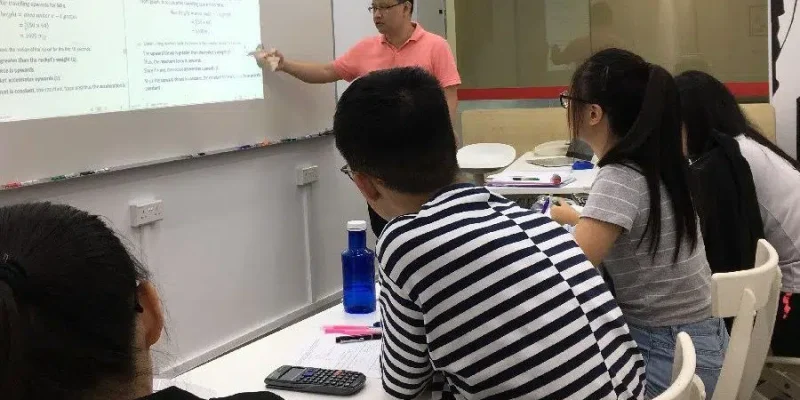
Their specialist tutors understand that students need to clearly visualise rotational forces to calculate them accurately. Through small class sizes, tutors can actively review how a student annotates their diagrams during practice sessions, immediately correcting any geometric mistakes. They provide comprehensive summary materials that highlight the most common examiner tricks, such as off-centre pivots or non-uniform objects. By rigorously practising these structured breakdown techniques on complex past year papers, students develop the analytical confidence needed to solve any turning effect question accurately.
Location and Contact Details
Students residing in the Serangoon area looking to master advanced mechanics can access our specialist programmes nearby:
TGC Academy (Potong Pasir)
Address – 107 Potong Pasir Ave 1, #01-K1, Singapore 350107
Phone – +65 8920 0792
Email – [email protected]
Web – https://www.tgc.sg/
Operating Hours:
Monday, Wednesday, Thursday, Friday: 3:00 PM – 10:00 PM
Saturday: 3:00 PM – 8:00 PM
Tuesday & Sunday: Closed
MAP Location-
FAQs
What is the Principle of Moments?
The Principle of Moments states that for an object to be in equilibrium, the sum of the clockwise moments about any pivot must be exactly equal to the sum of the anticlockwise moments about that same pivot.
Why is it important to draw the weight of a uniform beam exactly in the middle?
For a uniform object, its mass is distributed evenly. In physics, we simplify calculations by assuming the entire weight of the object acts through a single point called the centre of gravity, which for a uniform beam, is exactly at its geometric centre.
Can an object be in equilibrium if it is moving?
Yes. An object is in equilibrium if it has zero resultant force and zero resultant moment. This means it can be moving at a constant velocity without rotating.
How do you calculate perpendicular distance if the force is at an angle?
Students must use basic trigonometry. They draw a right-angled triangle using the line of action of the force and the pivot. Usually, the perpendicular distance can be found using the formula: distance = length of the beam × sine or cosine of the given angle.
Parents wanting to ensure their child possesses the geometric and analytical skills to handle complex physics diagrams can contact TGC ACADEMY to learn more about their structured revision methods.